 Quad Cities Home Pros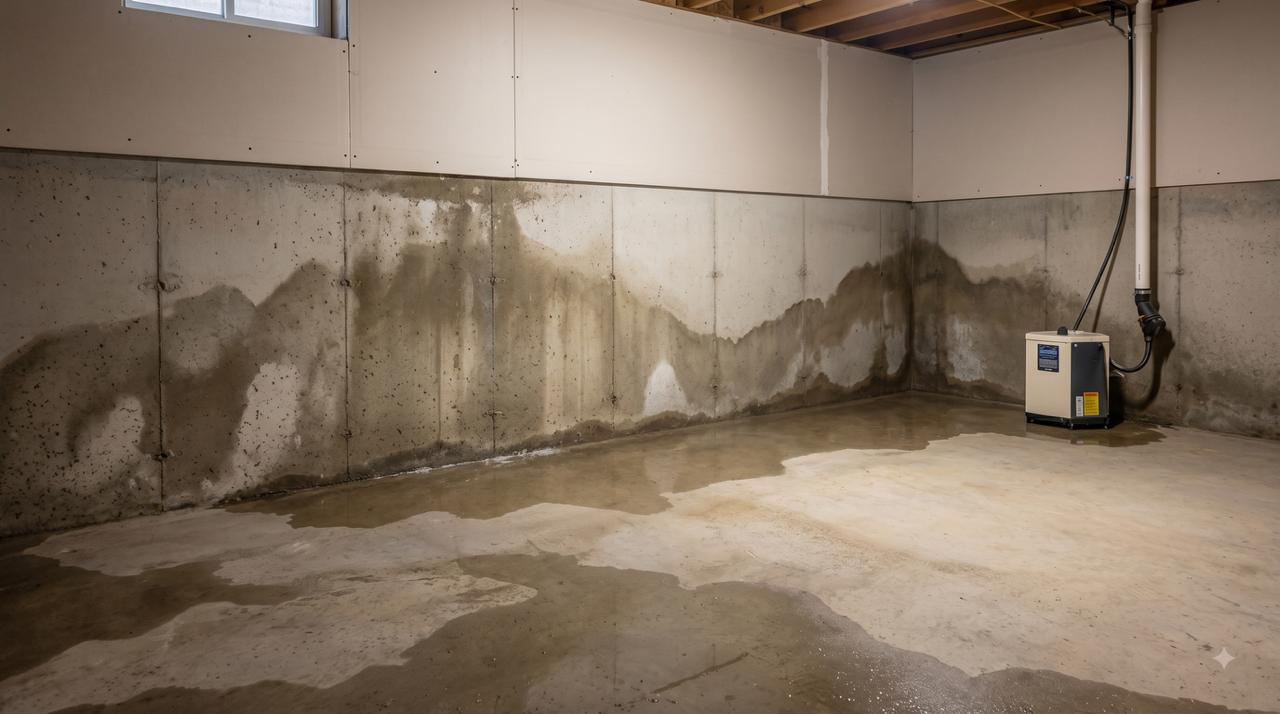
It is usually not the river
Living in a Mississippi river town makes flooding the first explanation people reach for, and river flooding is a genuine risk for properties in the flood plain. But most wet basements in this metro have nothing to do with the river. They are surface water that was not directed away from the house, groundwater pressing against the foundation, or a sewer backup.
This distinction is not academic. It decides which trade you need, whether your insurance is likely to respond, and whether the fix costs a Saturday afternoon or a contract.
The four ways water gets in
Surface water is rain that lands near the house and is not taken away — downspouts discharging at the foundation, ground sloping back toward the wall, window wells without drainage. This is the most common cause and the cheapest to fix.
Groundwater is the water table rising after sustained rain until it presses on the foundation from outside. That pressure finds the joint between the floor slab and the wall, which is why seepage often appears along the base of a wall rather than through it.
Sewer backup is water coming up through a floor drain or fixture rather than in through a wall. It is a different problem with a different fix, and it is the one you should not clean up casually.
Plumbing failure — a water heater, a supply line, a failed sump pump — is the fourth, and the one people assume last when the basement floods on a clear day.
Why heavy rain floods a basement that is dry the rest of the year
If your basement is dry for months and then wet within an hour of a downpour, that timing points at surface water rather than groundwater. Groundwater problems tend to arrive slowly and persist for days after the rain stops; surface water arrives with the storm and drains once it does.
Walk outside during the next heavy rain, unpleasant as that is, and watch where water goes. Overflowing gutters, a downspout emptying beside the wall, or a patio sloping toward the house will usually explain it faster than any inspection.
Clay soil and the freeze-thaw cycle
Much of this area sits on soils with a high clay content, which hold water rather than draining it and expand as they take it up. That swelling presses against foundation walls, and a season of wet followed by a season of dry works the soil against the structure repeatedly.
Quad Cities winters add a second cycle on top of that one. Temperatures here cross freezing repeatedly rather than settling below it, and water that gets into a crack and then freezes widens the crack every time. A hairline crack that has been ignored for several winters is not the same crack it was.
Bluffs, low ground, and where your house sits
This is not flat prairie. The metro has real topography, and a house at the bottom of a slope receives water from everything uphill of it regardless of how well its own drainage is arranged. Neighbouring properties, a resurfaced driveway or a new build up the hill can change how much water arrives at your foundation.
If a basement that was dry for a decade started taking water without any change to your own house, look uphill and ask what changed.
Sump pumps, and the problem with storm-season power cuts
A sump pump manages groundwater by collecting it and pumping it away. The weakness is obvious once stated: the water arrives during storms, and storms are when the power goes out. A pump with no backup is a pump that is off at the exact moment it is needed.
If you rely on one, know how it is backed up, and test it before spring rather than during it. A pump that has sat unused all winter is not known to work.
Which trade you actually need
Match the trade to the cause. Surface water is drainage and grading — often landscaping, sometimes gutters. Groundwater pressing on the structure is basement waterproofing. Cracking, movement or a bowing wall is foundation repair. Water coming up through a floor drain is a plumber.
One warning worth stating plainly, because it is easy to get wrong when you are searching in a hurry: a plumber who installs sump pumps is not a waterproofing contractor, and a waterproofing contractor is not a structural engineer. These trades sit next to each other and are routinely listed together, but doing adjacent work is not the same as offering the service. If a bowing wall or a structural crack is involved, the assessment should come from someone qualified to judge the structure.
Ask any contractor to tell you which of the four causes they think you have, and why. An answer that skips straight to a solution without naming the cause is worth a second opinion.
Insurance is not one thing
Standard homeowners policies generally do not cover flood, which is written separately. Sewer or drain backup is often a separate add-on again, and a sudden burst pipe is usually treated differently from long-term seepage that could have been maintained against.
The practical consequence is that the cause of the water decides the coverage. Read your own policy or ask your agent before you assume, and photograph everything before you start cleaning up.